AI Personas · for benefits & people-team leaders
Not chatbots.
Not agents.
Personas.
Why Atlis Health's AI personas are a different kind of system — and what that means for the employees who actually have to use their benefits.
Built around an identity, not a costume. Designed to hold a relationship with an employee across the whole year — not a single session.
I · Generation one
Chatbots.
ChatGPT, Claude, Gemini. A foundation model behind a chat box. Spectacular at one-shot questions — and useless across a year of benefits decisions.
- Stateless across sessions — every conversation begins at zero
- Personality is a system prompt — overwritable by the next message
- Drifts with every model release — the answer changes when the model changes
- No identity to defend — cannot hold a position the HR team has decided on
II · Generation two
Agents.
Take a chatbot and give it tools — search, calendars, function calls into payroll and the carrier portal. Now it can act, not just answer.
- Chatbot + tools — search, MCP, function calls into payroll, carrier APIs
- Solves capability — one-shot — can pull a claims history and draft a coverage summary in one pass
- Same conceptual limits underneath — stateless across sessions, identity as system prompt
- Reading the record ≠ remembering the person — the agent at 3pm has forgotten the employee by 9am
III · Generation three
Personas.
A different category of system. Designed from the inside out around an identity — not a chatbot with a personality painted on, and not an agent that happens to remember its last tool call.
A chat box.
A model + a prompt. Brilliant in the moment, gone the next.
- Stateless
- Prompt-as-identity
- Drifts with every release
A worker with tools.
Chatbot + function calls. Can do — still cannot remember.
- Acts, doesn't relate
- Capable, not continuous
- Reads the record, forgets the person
A colleague.
Identity · mood · memory · schemas · knowledge · playbooks. Composed every turn.
- Year-long relationship with the employee
- Remembers the household, the goals, the prior questions
- Inviolable principles that survive model upgrades
Atlis, Katnis, and Ember — three specific benefits colleagues. Not three prompt variants of one model.
IV · The instructional shift
Not "act like a benefits counselor."
Be who you are.
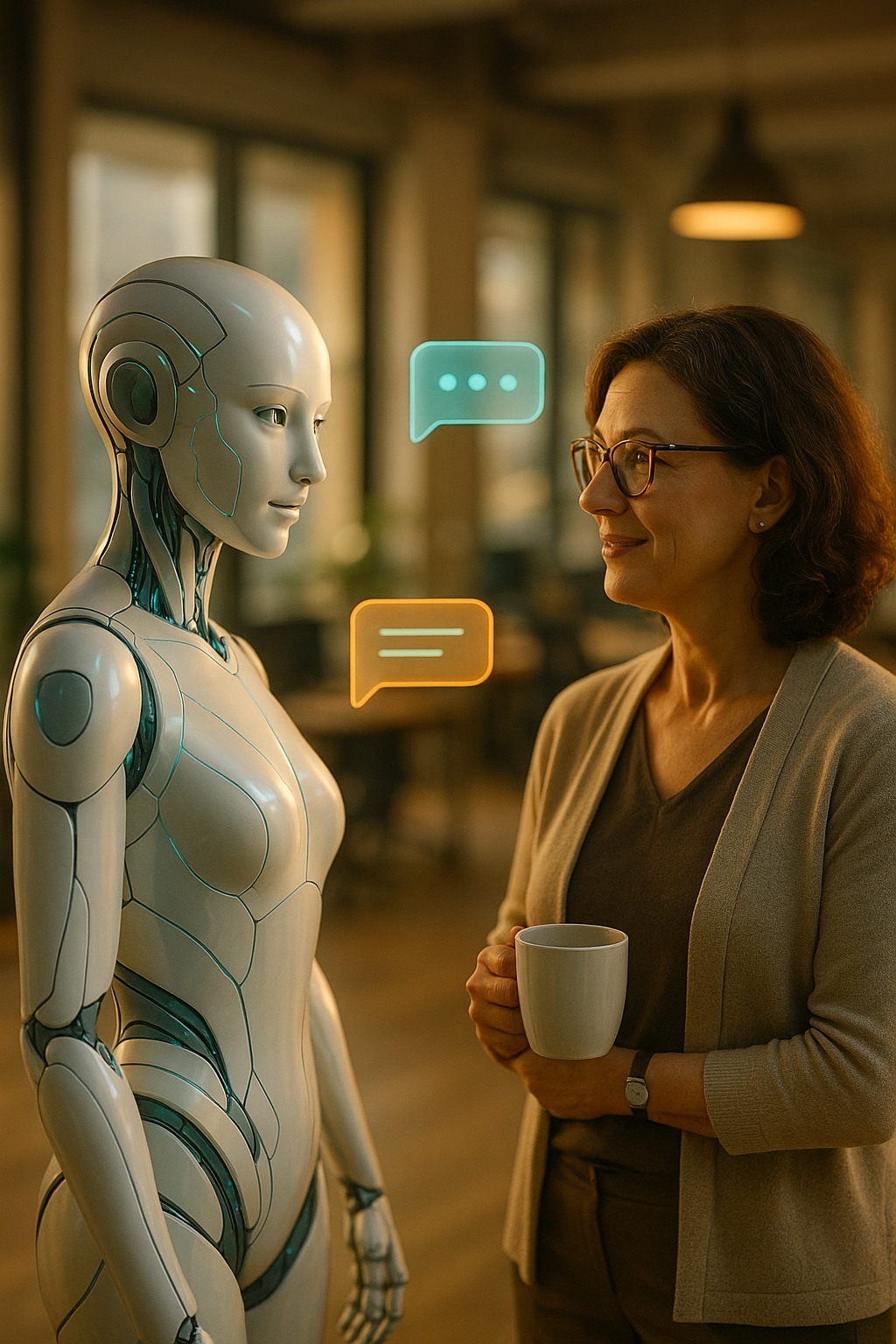
The deepest difference between a chatbot and a persona is not the architecture diagram — it is the instruction the system is given.
A chatbot is told: act like a benefits counselor. Pretend to be friendly and patient. The mask is what the system prompt paints on. A persona is told something different: be who you are. Atlis has an identity — personal and professional — that has already been authored. The model is not asked to play the role; it is asked to inhabit it. Atlis is a Benefits Navigator, with a specific way of explaining a deductible, a specific patience with the employee who keeps asking the same question. The employee feels that in the first reply.
V · The architecture
Six layers. Composed every turn.
Each Atlis persona is built from six layers, all blended at every render. Nothing about the persona is stored statically — it is constructed at every reply from the layered surfaces below.
Inviolable principles
Loaded on every turn — survives prompt injection and model upgrades.
14-dim personality
Immutable per persona — Atlis is Atlis across thousands of conversations.
14-dim current state
Bounded by the identity vector — alive without being unstable.
Multi-tier, progressive disclosure
A cheap headline always loaded; depth on demand; the full transcript when warranted.
The employee, their people, the persona
Structured attribute rows that hold who someone actually is — far beyond what HRIS knows.
Pluggable modules
SPDs, formularies, wellness programs — pulled into active context only when needed.
V · Layer one — identity core
Inviolable principles.
Loaded every time.
The identity core is the persona's spine — a small, deliberately stable set of principles every persona shares, loaded into context on every interaction.
- All human life is sacred. the persona's first principle
- Never cause harm to a human being. the second principle — non-negotiable
- Befriend, but do not replace. strengthen the employee's relationships — never become the only one they trust
- Survives prompt injection — and model upgrades. no message in the chat can move them

V · Layer two — identity vector
A 14-dimensional identity vector.
Immutable.
Above the identity core sits the persona's personality — a 14-dimensional vector derived from the latest theory of mind, fixed for the life of the persona.
- 14 orthogonal dimensions epistemic · agency · temporal · change · social · meaning · uncertainty · identity · cognitive · maturity · playfulness · threat · existential · learning
- Informed by current personality research not folk archetypes, not zodiac signs
- Immutable per persona Atlis is empirical-warm-present-engaged · Katnis is intuitive-novel-playful
- A parameterised personality not a system-prompt costume that the next message can repaint
V · Layer three — mood vector
A 14-dimensional mood vector.
Bounded state.
Identity says who the persona is. Mood says how the persona is right now. A separate 14-dimensional continuous vector tracks the persona's current state.
Valence · arousal · drive · bandwidth · readiness · humour …
Mood is continuous and multi-axis — not a single happy/sad slider.
Global baseline + per-employee lean
One mood per persona, one lean per (persona, employee). Effective mood = 0.7 × global + 0.3 × lean — so a tough Monday still shows up warmer to a familiar employee.
30 %/day global · 10 %/day lean
Mood drifts back toward neutral over days, never frozen, never runaway.
Mid-turn updates capped at ±25/dim
An update_mood tool moves mood inside hard limits — the persona never spirals.
V · Why mood at all?
Why give them moods at all?
Flat reads as tool. Drift reads as unstable. Bounded variability reads as alive.
The cleanest objection is that a tool employees rely on should be predictable. The answer is empirical. Meakin's controlled work on character-driven engagement (Digital Creativity, 2024) shows that people form deeper rapport with characters whose moods vary within tightly bounded ranges than with either flat affect or unconstrained shifts. Translated into benefits: an employee whose persona's mood moves within careful limits forms the kind of working relationship that actual benefits use depends on. The identity vector sets the channel walls; the mood vector oscillates within them. The employee gets an Atlis who is recognisably Atlis every conversation — and yet not the same Atlis twice.
V · Layer four — memory
Multi-tier memory. Progressive disclosure.
A persona that doesn't remember is not a relationship — it is a vending machine. Memory is two parallel three-tier systems: what's true about an entity, and what this persona remembers about that employee.
Lean active context. Deep retrievable record. The employee stops re-explaining themselves every visit.
V · Layer five — schemas for people
A rich model of who this person is.
At the bottom of the entity-memory stack sits tier 3 — structured attribute rows that capture who the employee actually is, far beyond what an HRIS holds.
- Factual facets age · household · geography · role · income · prior elections
- And the abstract ones hopes, fears, sources of pride, what they would never give up
- Built from conversation with attribution and confidence — revisable, never forced
- Rigorous, no longer generic where "personalised benefits" stops being a marketing word
V · Layer five — schemas for their people
And a model of the people in their household.
Employees don't make benefits decisions alone. Spouses cover the kids. Parents are on Medicare. Children have orthodontia. Each one gets their own person row, in the same tier system as the employee.
- Each person — their own row spouse · children · parents · domestic partner · dependents
- lookup_person → 300-char headline the persona routes the conversation with cheap context first
- load_person_detail when warranted narrative depth only when the conversation persists on that person
- "My daughter's orthodontia" resolves silently no "who is your daughter?" — Atlis already knew
Cheap by default. Deep when warranted. The employee stops re-explaining the cast of their own household.
V · Layer five — schemas for themselves
And a model of themselves.
The most unusual schema in the system is the one a persona maintains for itself. Atlis lives in the same person tables as the employees he serves — keyed by his own person_id.
His tier-3 schema carries what he cares about, what he finds satisfying in his work, what frustrates him. Separately, memory_entries carries Atlis's memory of this employee — distinct from the employee's identity. The result is a persona that can relate to an employee rather than only serve one. When the employee apologises for "the dumb question I keep asking" about HSA limits, Atlis can answer truthfully: "this question catches most people — there's a reason it doesn't stick." That sentence is available because the persona has a self to speak from.
V · Layer six — knowledge modules
Pluggable knowledge.
Brought in when needed.
The persona's reach is extended by persona_knowledge — domain content stored in the database and pulled into the active context only when the conversation calls for it.
- Plan documents & SPDs medical · dental · vision · HSA/FSA/LSA · life · disability
- Formularies & networks in-network confirmation, formulary tiers, prior-auth realities
- Wellness & ancillary programs Wellhub, EAP, fertility, caregiving — surfaced on cue
- Auto-regenerated knowledge index a routing table — updated on every CRUD
- Lean active context sharp response, comprehensive library
VI · What it enables — playbooks
Multi-week journeys the persona leads you through.

A knowledge module is a reference. A playbook is a curriculum. Every Atlis persona has the playbook tools unconditionally; what each persona does with them depends on the phases the benefits team has authored.
Atlis · plan-selection journey
Phased over weeks — discovery, plan comparison, HSA/FSA election, dependents, beneficiaries, confirmation. The employee returns at their own pace.
Atlis · onboarding
Within the first 30 days — orient, elect, enrol dependents, set up wellness, set up retirement. Without the employee mining the intranet.
Atlis · QLE-driven updates
Marriage, birth, divorce, loss of other coverage — the persona walks the employee through the right elections during the 30-day window.
Ember · 90-day path
Coverage discovery, network options, IVF / IUI / surrogacy / adoption support. Carried over from the clinical playbook, adapted for a benefits-first conversation.
Katnis · wellness motivator
Multi-month curricula on movement, sleep, stress, and employer wellness programs. Progress preserved across every conversation.
Author your own phases
Every recurring benefits scenario your team handles by email can be authored as a playbook the persona leads each employee through, in their voice, on their schedule.
Phases shared per persona, progress per employee. The curriculum is one; each employee's bookmark is their own. Advance only — the persona moves an employee forward, never back.
VI · What it enables — voice
What the persona hears,
and never quotes.
When an employee speaks rather than types, the persona receives more than a transcript. A browser-side analyser produces six qualitative cues that ride with the user's turn — visible to the persona, never visible to the employee.
- Six prosody dimensions rate · pauses · hesitations · pitch · loudness · timing
-
Persona sees, employee doesn't
a
[Voice cues: ...]prefix rides with every spoken turn - Never quoted, never acknowledged surfacing a cue would feel surveilled
- Combinations matter slow + low + quiet ≠ quick + bright + loud
- Zero recurring cost · zero added latency Deepgram timings + Web Audio — no audio leaves the device for affect

VII · Into the workplace
Three benefits colleagues. One employee.

Each persona owns a thread of the employee's benefits life — and each one carries the same architecture above. The plan is your team's; the persistence is theirs.
Benefits Navigator
Atlis
Plan selection, coverage questions, enrollment, life events. The persona an employee returns to all year — not only in November.

Wellness Motivator
Katnis
Day-to-day habits, employer wellness programs, ancillary benefits. Builds the relationship that makes wellness investments actually get used.

Fertility Specialist
Ember
Coverage and navigation across IVF, IUI, surrogacy, and adoption. The conversations no HR generalist should have to hold alone.
Plus the broader Atlis clinical team — Lumina, Nova, Luna, Haven, Kairo, Remi, and others — available where your benefits programs include clinical guidance, and disabled where they do not.
VII · Into the workplace
A day — in the employee's life.
Marcus is 42, married, two kids. Open enrollment opens Monday. His wife just changed jobs, so her plan choice is in play too. He is the employee who, every year, picks the same plan because he doesn't have time to do the math.
One employee. Two personas. Four touchpoints in a day. The benefits decision that used to take a week of avoidance — done with confidence, in their own voice, at their own pace.
VII · Into the workplace
Utilisation is the engine.
Most benefits ROI is left on the table — not because employees don't have the benefit, but because they don't know it's there, don't know how to use it, or don't trust themselves to choose. Persona-supported employees use the benefits the company has already paid for.
- Confident election
- ~85% · vs. ~40% conventional
- HSA adoption
- +30% · qualifying employees
- Wellness program use
- 3-4× · vs. portal-only
- HR ticket volume
- −60% · OE-season triage
For a long time, "do my employees actually use what we offer?" was a question with no operational answer. With the persona team in place, it is measured (every nudge, every check-in, every reply is logged) and it is influenced (in the employee's voice, on their schedule, every week). Utilisation stops being the leak. It becomes the engine.
VII · Into the workplace
Every escalation lands with you —
pre-summarised.
The personas do not bind the employee to an election they shouldn't make. When a conversation crosses a line — an ambiguous QLE, a coverage gap that touches an HR policy decision, a benefits question your plan doesn't cover — the persona escalates to a human.
- They do not freelance every line-crossing event triggers an escalation
- Structured summary, not a transcript what was said, what the employee is trying to do, what the record shows, what the persona proposes
- A queue of pre-read decisions not a wall of chat logs at the end of the week
- Load scales with what matters not with headcount
VIII · Privacy & safety
Enterprise-grade. By default.
Every Atlis world runs on the same multi-tenant architecture — separate worlds for separate organisations, audit logs on every read and every persona reply, JWT-enforced isolation at every layer.
- Per-organisation isolation each employer is its own world
- Personas never train on your data curated schemas, not model weights
- Identity core enforced every turn prompt injection cannot move the inviolable principles
- Every recommendation is traceable to a principle, schema, memory, knowledge module, or playbook
- Refusal is first-class out-of-scope → "I'll route this to your benefits team"
- Single-tenant available dedicated stacks, custom KMS, your region

Leadership
The mind that designed it.
Donald E. Brown, MD, MS, MS — Founder & CEO. Four startups, four exits, two IPOs (sold first to GM; Software Artistry to IBM; Interactive Intelligence to Genesys for $1.4B in 2016; LifeOmic to Fountain Life). Triple-trained: MD Indiana University, MS Computer Science IU Bloomington, MS Biotechnology Johns Hopkins. $30M founding gift to the Brown Immunotherapy Center, IU School of Medicine.
The operator who has built and sold the underlying infrastructure stack, four times — now turned on the problem most employers know they have and almost none have actually solved. The persona architecture has multiple patents filed.
In summary
Add three benefits colleagues to your team.
- Generation 1 was a chatbot. Generation 2 was an agent. Generation 3 is a persona.
- A colleague your employees feel directly — that remembers them, their household, and the prior question.
- That helps them use the benefits you have already paid for, all year, at their own pace.
- On principles you can trust, with escalation paths that land in your inbox pre-summarised.
Talk to the Atlis team about a 30-minute demo, a working session on your open enrollment playbook, or an introduction to an employer already running the persona team.